Newer
Hailin Automation and China Mobile Internet of Things signed a strategic cooperation agreement


English
English
 Deutsch
 Français
 한국어
한국어
 Русский
 Português
 O‘zbekcha
 Español
 עִבְרִית
 العربية
 Türkçe
 Italiano
 Nederlands
 Română
 Čeština
 Suomi
Suomi
 日本語
日本語
 Filipino
 ไทย
ไทย
 മലയാളം
 Українська
 Српски
 Tiếng Việt
 Bahasa Melayu
 Dansk
Dansk
 Svenska
 Norsk
Norsk
 Latviešu valoda
 Български
 Magyar
 हिन्दी
ਪੰਜਾਬੀ
Basa Jawa
हिन्दी
ਪੰਜਾਬੀ
Basa Jawa
 Bahasa Indonesia
 Polski
 Kiswahili
 Ελληνικά
 বাংলা
বাংলা
 فارسی
فارسی
 Беларуская
 中文
中文
 اردو
اردو
 Қазақша
Malay
Tamil
Қазақша
Malay
Tamil
 Khmer
Khmer
 Lao
Lao
 Burmese
English
English
Deutsch
Français
한국어
Русский
Português
O‘zbekcha
Español
עִבְרִית
العربية
Türkçe
Italiano
Nederlands
Română
Čeština
Suomi
日本語
Filipino
ไทย
മലയാളം
Українська
Српски
Tiếng Việt
Bahasa Melayu
Dansk
Svenska
Norsk
Latviešu valoda
Български
Magyar
हिन्दी
ਪੰਜਾਬੀ
Basa Jawa
Bahasa Indonesia
Polski
Kiswahili
Ελληνικά
বাংলা
فارسی
Беларуская
中文
اردو
Қазақша
Malay
Tamil
Khmer
Lao
Burmese
A Direct Digital Controller (DDC) is a programmable microprocessor-based device that receives input from sensors, executes control logic such as PID loops and scheduling, and sends output signals to actuators, valves, and other HVAC equipment. It is the core computing node in a Building Automation System (BAS), enabling centralized monitoring and automated control of heating, ventilation, and air conditioning systems.
For HVAC distributors, system integrators, and procurement managers, selecting a DDC controller supplier is a strategic decision. The controller is the brain of the building automation system. Choose poorly, and integration failures, communication mismatches, and costly rework follow. Bulk orders amplify these risks. This guide provides a structured framework for supplier evaluation, grounded in industry standards and real-world project requirements.
DDC controllers differ from commoditized HVAC components. They run embedded firmware, support multiple communication protocols, and must interoperate with various BMS platforms. Without proper evaluation, procurement teams risk ordering controllers that cannot communicate with the specified BMS, lack the I/O capacity for the project, or fail to meet cybersecurity requirements.
A DDC controller must interoperate with the building’s BMS. The dominant protocols in commercial HVAC are BACnet and Modbus. Verify support for both IP and serial variants.
| Protocol | Typical Application | Key Advantage |
|---|---|---|
| BACnet/IP | Large commercial buildings, campus BMS | Native interoperability with 60+ BMS brands |
| BACnet MS/TP | Floor-level zone control networks | Cost-effective distributed communication |
| Modbus TCP | Industrial facilities, data centers | Simple Ethernet-based integration |
| Modbus RTU | Legacy upgrades, sensor networks | Reliable serial communication over long distances |
The HD series DDC controller supports all four protocols simultaneously across dual RS-485 and Ethernet interfaces, enabling flexible integration without additional gateways.
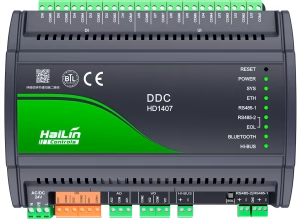
Projects vary widely in I/O requirements. Controllers with programmable Universal Input/Output (UIO) points allow software-based configuration, reducing inventory complexity. One model serves multiple project types. Check the number of onboard I/O points, maximum I/O expansion modules per controller via RS-485 daisy chain, and support for button-enabled termination resistors.
Modern DDC controllers handle scheduling, alarm management, data logging, and edge analytics. Underpowered controllers create bottlenecks in large projects.
| Specification | Entry-Level | Mid-Range | Advanced |
|---|---|---|---|
| CPU Core | ARM Cortex-M3 | ARM Cortex-M4 | ARM Cortex-M4+ |
| Clock Speed | 120 MHz | 240 MHz | 240 MHz+ |
| Flash Memory | 2 MB | 2–4 MB | 8 MB+ |
| SDRAM | 512 KB | 512 KB–1 MB | 8 MB+ |
| Real-Time Clock | Optional | Built-in | Built-in with supercapacitor backup |
With BAS networks increasingly connected to IT infrastructure, cybersecurity is critical. Key features to verify include hardware encryption chip supporting SM2, SM4, or AES standards, secure boot to prevent unauthorized firmware, encrypted remote firmware updates, role-based user access at the controller level, and separate physical Ethernet ports for BAS and IT networks where required.
The supplier’s programming tool directly affects engineering productivity. Evaluate whether it offers graphical block-based programming rather than text-only coding, a pre-built HVAC control sequence library for AHU, chiller, VAV, and heat pump applications, offline simulation and debugging, and free distribution to system integrators without per-seat license fees.
Global certifications verify product safety, interoperability, and manufacturing consistency.
| Certification | Scope | Why It Matters |
|---|---|---|
| UL 916 | North American safety standard | Required for projects in US and Canada |
| CE (EMC + LVD) | European market access | Mandatory for EU-based projects |
| BTL (BACnet Testing Labs) | BACnet protocol verification | Guarantees BMS interoperability |
| RoHS | Hazardous substance restriction | Required for environmental compliance |
| CMMI Level 3 | Software development maturity | Indicates reliable firmware quality |
For bulk orders, logistics and support directly impact project timelines. Evaluate typical lead time for 100+ units, regional warehousing or drop-shipping availability, warranty period, RMA process for defective units, technical support hours relative to your time zone, and on-site commissioning support for large projects.
| Criteria | Weight | Supplier Score (1–5) | Weighted Score |
|---|---|---|---|
| Protocol compatibility | 20% | ||
| I/O flexibility | 15% | ||
| Processing & memory | 15% | ||
| Cybersecurity | 10% | ||
| Programming tool | 15% | ||
| Certifications | 15% | ||
| Logistics & support | 10% | ||
| Total | 100% |
DDC controllers are optimized for building automation with native support for BACnet and HVAC-specific control sequences like PID, scheduling, and enthalpy calculation. PLCs are designed for industrial automation and require more customization for HVAC applications. DDC controllers generally have lower per-point cost for BAS projects.
Yes, if they communicate via open protocols such as BACnet/IP or Modbus TCP. BTL certification verifies BACnet interoperability. However, mixing brands increases engineering complexity and may void system-level performance guarantees.
A mid-range DDC controller typically has 12–24 onboard I/O points and can be expanded to 100+ points via I/O extension modules connected through RS-485. The HD1407 supports up to 5 extension modules per RS-485 interface.
Most DDC controllers have a service life of 10–15 years in normal operating conditions. Factors affecting lifespan include power quality, ambient temperature, humidity, and firmware support from the manufacturer.
Yes. Compact DDC controllers with 4–8 I/O points are available for small commercial buildings, retail stores, and standalone HVAC systems. They share the same BACnet and Modbus compatibility as larger models, enabling future expansion.
DDC controller procurement should be evaluated across multiple dimensions, not just unit price. Protocol compatibility, I/O flexibility, processing power, cybersecurity, programming tools, certifications, and after-sales support all affect total cost of ownership and project outcomes. Using a structured evaluation framework helps procurement teams make informed decisions and build reliable long-term supply relationships.