Newer
Where Can Buy Motorized Balancing Valves for Commercial HVAC in Bulk?


English
English
 Deutsch
 Français
 한국어
한국어
 Русский
 Português
 O‘zbekcha
 Español
 עִבְרִית
 العربية
 Türkçe
 Italiano
 Nederlands
 Română
 Čeština
 Suomi
Suomi
 日本語
日本語
 Filipino
 ไทย
ไทย
 മലയാളം
 Українська
 Српски
 Tiếng Việt
 Bahasa Melayu
 Dansk
Dansk
 Svenska
 Norsk
Norsk
 Latviešu valoda
 Български
 Magyar
 हिन्दी
ਪੰਜਾਬੀ
Basa Jawa
हिन्दी
ਪੰਜਾਬੀ
Basa Jawa
 Bahasa Indonesia
 Polski
 Kiswahili
 Ελληνικά
 বাংলা
বাংলা
 فارسی
فارسی
 Беларуская
 中文
中文
 اردو
اردو
 Қазақша
Malay
Tamil
Қазақша
Malay
Tamil
 Khmer
Khmer
 Lao
Lao
 Burmese
English
English
Deutsch
Français
한국어
Русский
Português
O‘zbekcha
Español
עִבְרִית
العربية
Türkçe
Italiano
Nederlands
Română
Čeština
Suomi
日本語
Filipino
ไทย
മലയാളം
Українська
Српски
Tiếng Việt
Bahasa Melayu
Dansk
Svenska
Norsk
Latviešu valoda
Български
Magyar
हिन्दी
ਪੰਜਾਬੀ
Basa Jawa
Bahasa Indonesia
Polski
Kiswahili
Ελληνικά
বাংলা
فارسی
Беларуская
中文
اردو
Қазақша
Malay
Tamil
Khmer
Lao
Burmese
Thermostat selection is easy to get wrong in hydronic radiant floor heating. A thermostat may look suitable on the product page but still fail to match the heat source, valve, sensor, wiring, or zone control setup.
For distributors, the safest approach is to check the system first and the thermostat second. The key points are temperature sensing, zoning, electrical requirements, heat source compatibility, and communication with other HVAC controls.
Hydronic radiant floor heating uses warm water flowing through tubing below or within the floor. The floor releases heat gradually, so the system does not respond as quickly as forced air heating.
The thermostat measures the room temperature and calls for heat when the room falls below the set point. In a zoned system, the thermostat may control a valve or actuator connected to the heating circuit.
A typical setup can include a thermostat, zone control, valve or actuator, manifold, and boiler or heat pump.
The slower response of radiant heating also affects thermostat settings. Large temperature setbacks can lead to long recovery times, especially in systems with high thermal mass. WBI recommends smaller setbacks for concrete slab systems than for forced air systems.
Room temperature sensing is the basic requirement. Some radiant heating applications also need a floor sensor.
A floor sensor can monitor floor temperature and provide a floor temperature limit where the flooring material or system design requires one. External floor sensing is especially useful when floor temperature matters as much as room temperature.
Outdoor temperature sensing is another option. Outdoor data can be used in heating systems designed around weather compensation or outdoor reset control.
The important question for a distributor is simple: What sensors does the thermostat support, and what does the control system do with the sensor input?
Radiant floors warm and cool slowly. A thermostat designed only around fast temperature changes may not be the best fit for a high mass radiant system.
For most projects, the goal is steady room temperature rather than frequent heating cycles. Programmable schedules can still help, but aggressive temperature setbacks are not always practical.
Hydronic systems are often divided into several heating zones.
A residential property may have separate zones for bedrooms, living areas, and bathrooms. A commercial building may need independent control for offices, guest rooms, or other occupied areas.
Before selecting the thermostat, distributors should confirm the number of zones and how each zone is controlled. Valve type, actuator type, control modules, and wiring all affect compatibility.
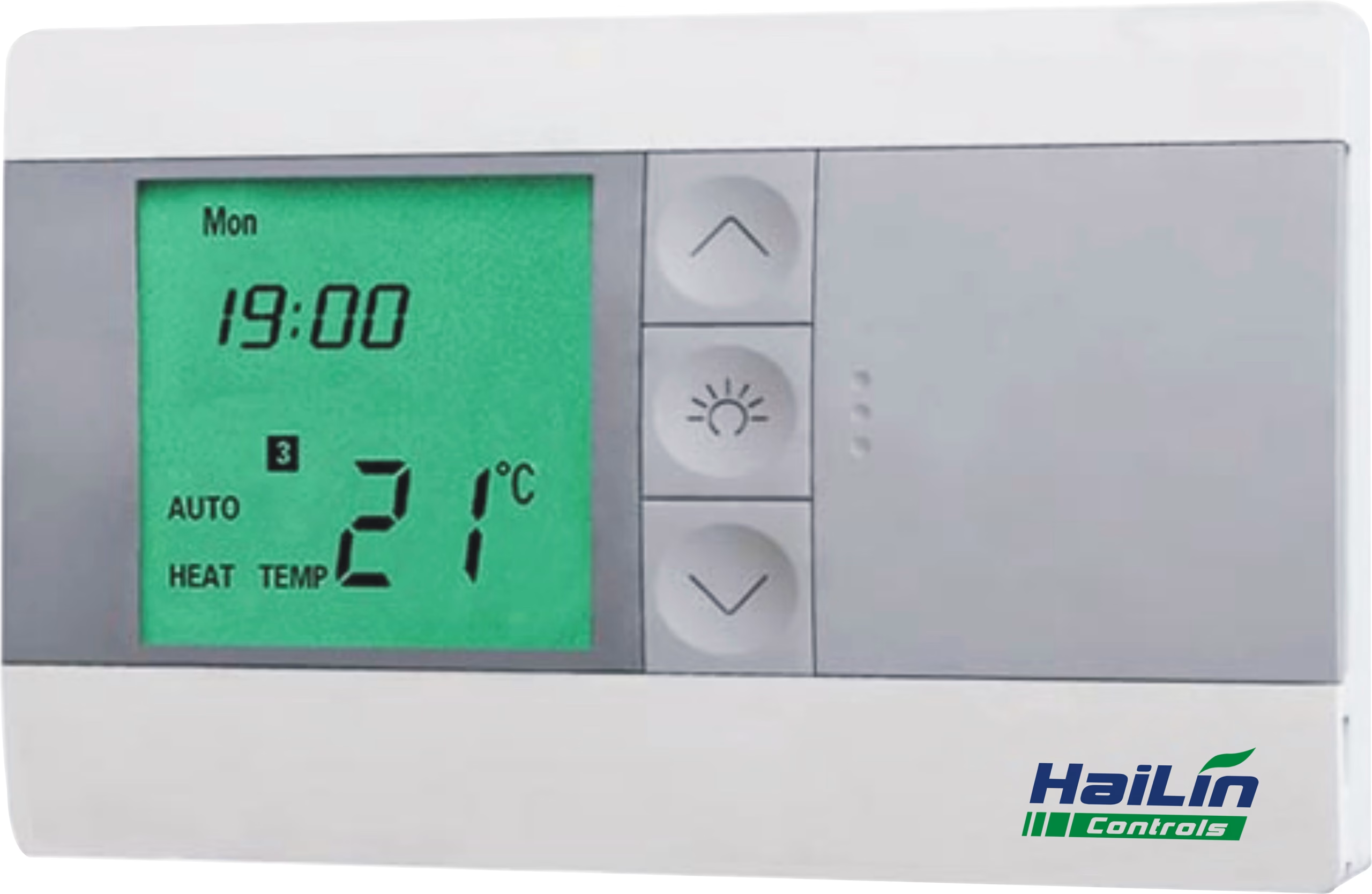
A thermostat specification sheet should answer the questions below.
| Item | What to Check |
|---|---|
| Temperature sensing | Room sensor, floor sensor, outdoor sensor |
| Zone control | Number of zones and control method |
| Heat source | Boiler, heat pump, or other compatible source |
| Valve control | Valve or actuator type |
| Power supply | Voltage and frequency |
| Wiring | Terminal arrangement and wire requirements |
| Communication | RS 485, Modbus RTU, or other interface |
| Scheduling | Daily or weekly programmable control |
| Connectivity | WiFi or app control where required |
| Certification | Approvals required in the target market |
Voltage deserves special attention. A thermostat designed for 24 V AC should not be treated as a direct replacement for a model designed for higher voltage systems.
Communication also needs to be checked before ordering. A thermostat for standalone room control is not automatically suitable for a building automation system.
Smart functions are useful when the project actually needs remote access or connected control.
A programmable thermostat may be sufficient for a home with regular occupancy. A smart thermostat becomes more useful when users need remote temperature adjustment, app access, or connected property management.
The same principle applies to distributors. Adding WiFi does not solve a compatibility problem. The thermostat still needs the correct power supply, control outputs, sensors, and system interface.
Thermostats for different HVAC systems often have very different control requirements.
A thermostat for hydronic radiant floor heating normally focuses on heating demand, temperature sensing, and zone control.
A fan coil thermostat may need fan speed control as well as valve control. Two pipe and four pipe FCU systems also use different control arrangements.
HaiLin’s HL2036/8036 Series is designed for FCU applications. The series includes models for two pipe and four pipe systems, with AC three speed fan control and on or off electric valve control. Selected models also provide RS 485 communication with Modbus RTU for building control integration.
Heat pump thermostats have another set of requirements. Depending on the equipment, the thermostat may need to handle multiple heating stages, Emergency Heat, or other heat pump specific control signals.
For distributors, the system type should always be confirmed before the thermostat model.
Residential projects usually need stable temperature control, simple scheduling, and suitable sensor options.
A floor sensor can be useful where floor temperature needs to be monitored. Zoning can also make sense in larger homes with different temperature requirements in different rooms.
Commercial buildings often have more zones and more control points.
Hotels, offices, healthcare buildings, and similar projects may require centralized HVAC control. Communication and integration become more important when individual room thermostats need to connect to a wider building automation system.
A hydronic system using a heat pump should be checked against the thermostat specifications before purchase.
Confirm the supported heat pump configuration, heating stages, power supply, and control terminals. Outdoor temperature input may also be relevant where the system uses weather based heating control.
For multi zone projects, buying the thermostat first is usually the wrong starting point.
Start with the zone layout, then confirm the valve or actuator arrangement, controller, thermostat wiring, and communication method. The thermostat should fit the existing control architecture.
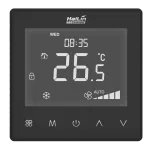
A reliable thermostat manufacturer should be able to provide clear answers to a few practical questions.
Ask which HVAC systems the thermostat supports and which configurations are actually tested.
For heat pump projects, confirm the heating stages and Emergency Heat requirements. For hydronic systems, confirm the control method for valves, actuators, or zone controllers.
Ask whether the model supports room, floor, or outdoor sensors.
For external sensors, check the sensor type, input terminals, supported temperature range, and available control settings.
Always confirm supply voltage, frequency, terminal layout, load ratings, and wiring requirements before placing an order.
A small mismatch in electrical specifications can turn a simple thermostat replacement into an installation problem.
For larger projects, ask about communication interfaces and building automation integration.
Distributors should also request wiring diagrams, installation instructions, technical data sheets, certification documents, and model lists. Clear documentation makes product selection easier for both distributors and installers.
HaiLin has separate thermostat products for different HVAC applications, so distributors can evaluate products according to system requirements.
The Thermostat category covers the broader product range. Dedicated categories are also available for heating thermostats, fan coil thermostats, and other HVAC control products.
For residential HVAC applications, EasyStat is a WiFi programmable thermostat for compatible air conditioners, furnaces, heat pumps, dual fuel systems, and selected FCU applications in the US market. The current product specification lists 24 V AC power, 2.4 GHz WiFi, support for up to 3H/2C systems with Emergency Heat, and FCC certification.
For FCU projects, HL2036/8036 Series covers two pipe and four pipe systems, AC three speed fan control, and on or off electric valve control. Selected models also support RS 485 Modbus RTU communication.
The product choice should follow the HVAC application. Smart features, scheduling, and connectivity should come after compatibility has been confirmed.
Choosing a thermostat for hydronic radiant floor heating starts with the system, not the feature list. Check sensors, zones, heat source, valve control, voltage, wiring, and communication before comparing smart functions or price.
For distributors, supplier support matters too. Clear specifications, wiring information, certifications, and technical documentation can reduce compatibility issues and make product selection easier.
Explore HaiLin’s thermostat products or contact the team to discuss thermostat requirements for your HVAC projects.