English
English
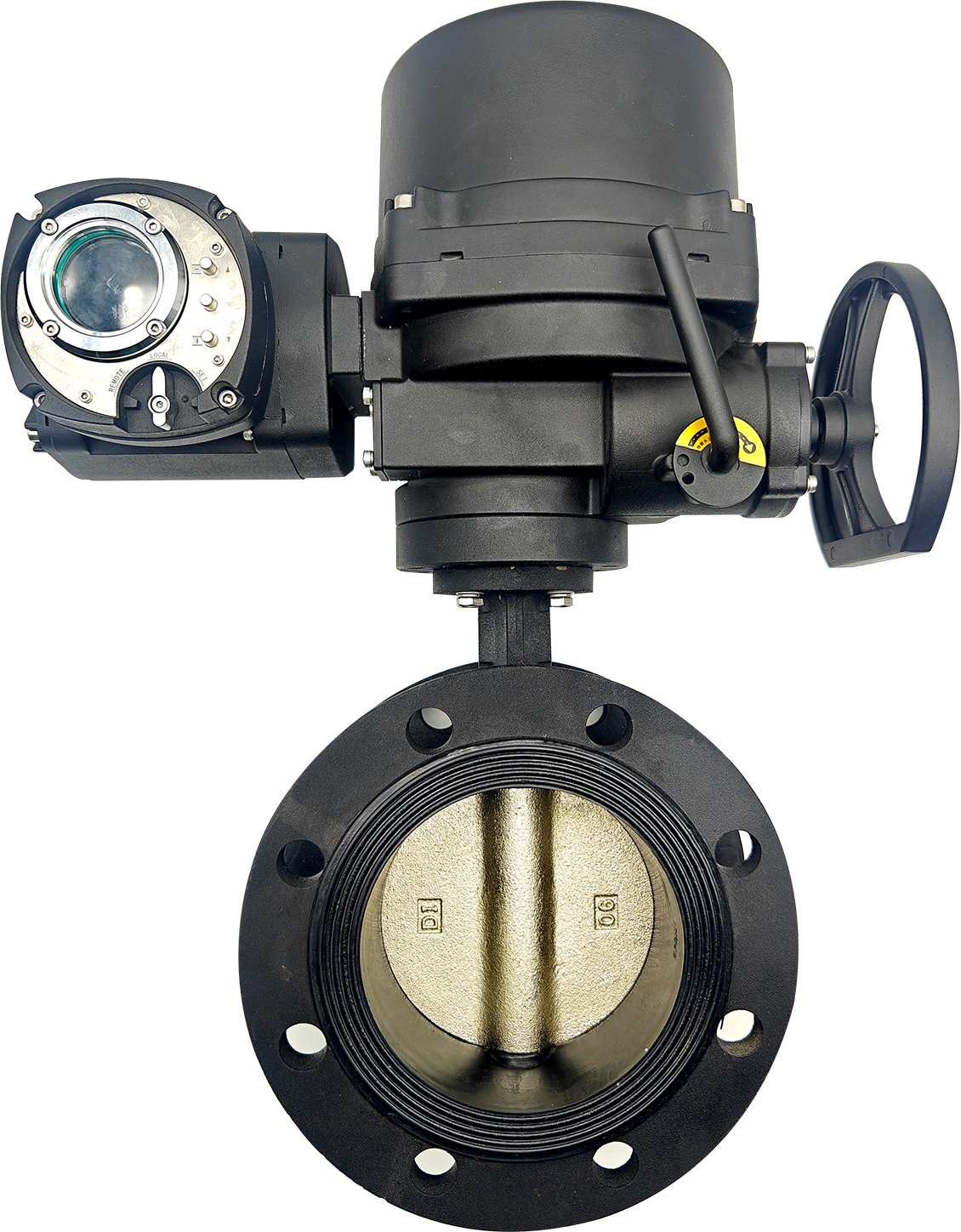
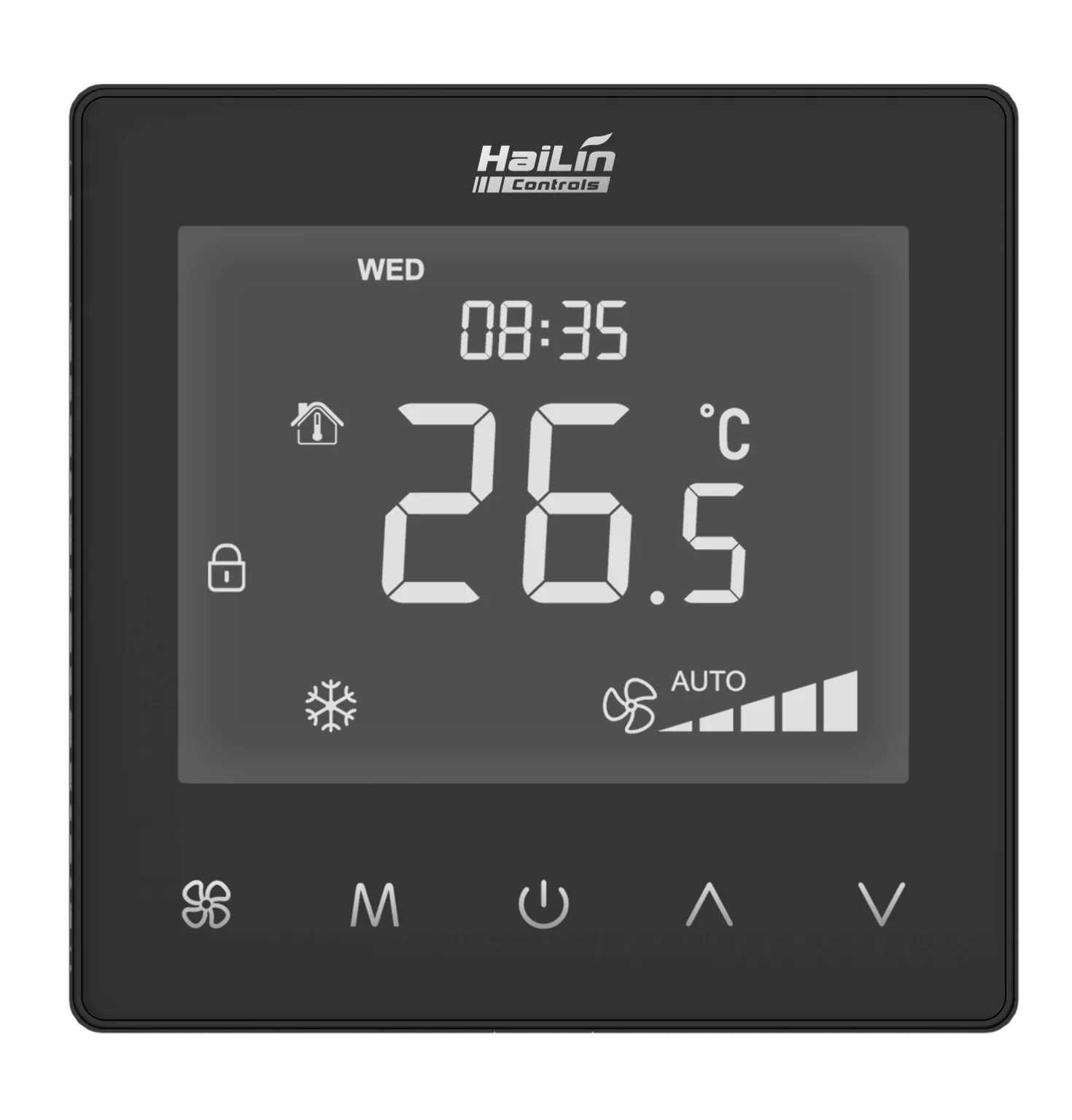
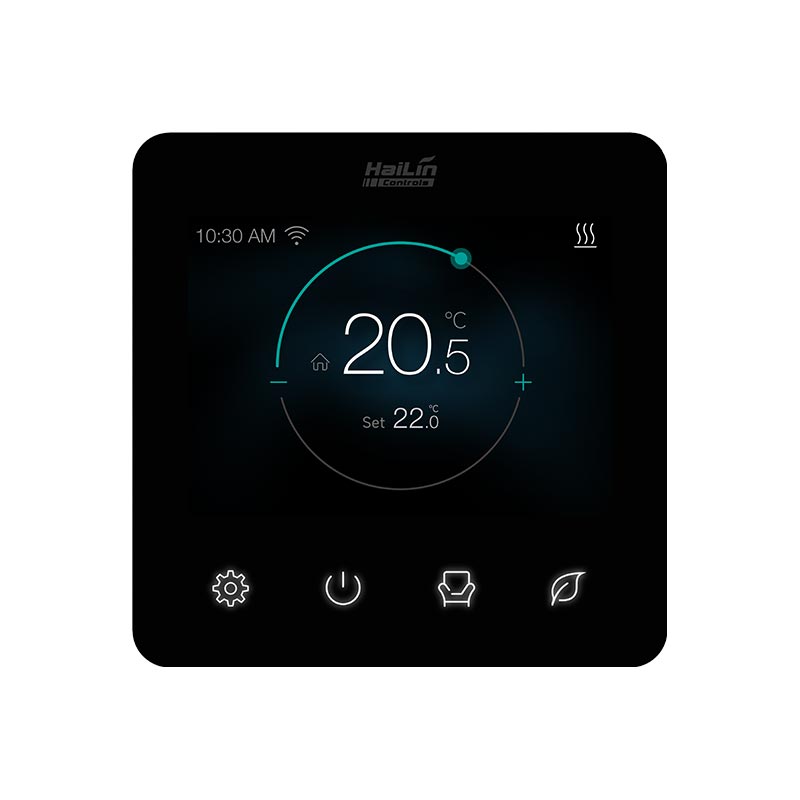
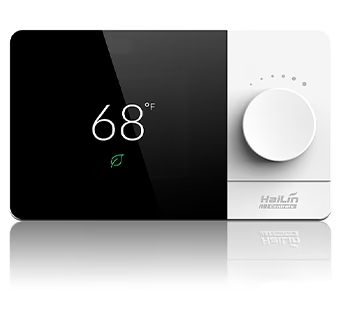
Verstiled series is a big family which is suitable for most kinds of heating and air-conditioning terminal control or equipment control. PI Control models in this series are suitable for precise environmental temperature control. It regulates valve outputs by using proportional-integral algorithm. The 0-10V output signal can be used to control various electric modulating valves in fancoil unit, fresh air unit, air handling unit, and heat exchanger. With RS-485 interface it can be integrated by BA System via Modbus-RTU protocol.
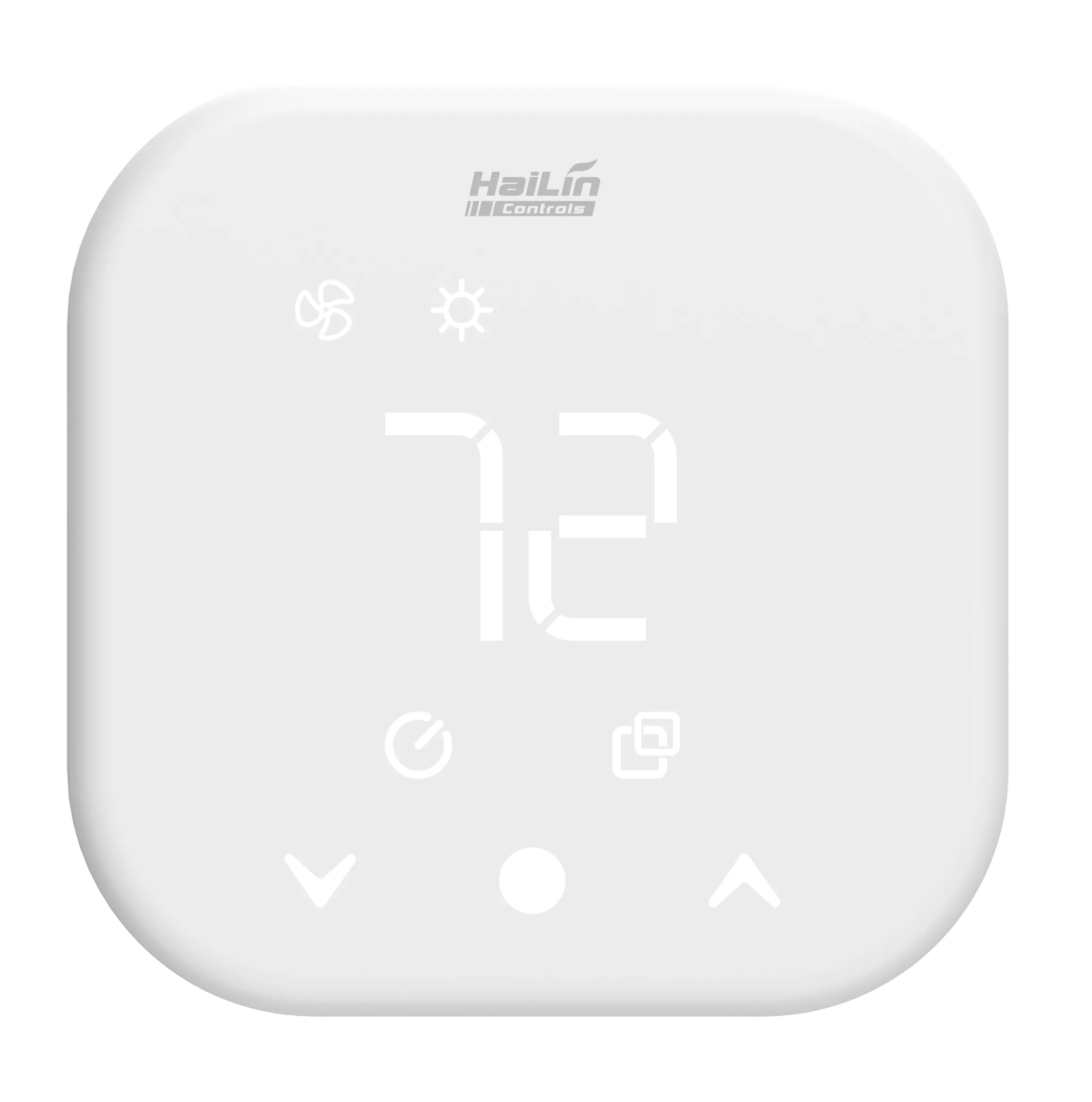
The Versatiled Series PI Control Thermostat is a versatile room temperature controller designed for precise heating and air-conditioning terminal control. It uses a proportional-integral (PI) control algorithm to continuously adjust valve output according to the difference between the room temperature and the target setpoint.
The 0–10V output can control compatible electric modulating valves in fan coil units, fresh air units, air handling units, and heat exchangers. Selected models also support RS-485 communication and Modbus-RTU, allowing integration with building automation (BA) systems.
The Versatiled Series provides multiple configurations for 2-pipe and 4-pipe FCU systems, different actuator types, AC three-speed or BLDC fan control, remote temperature sensing, scheduling, and valve control. This makes the series suitable for both standalone terminal control and integrated HVAC automation projects.
A PI control thermostat uses proportional and integral control to regulate the output according to the current temperature deviation and accumulated temperature error.
Compared with simple on/off control, PI control continuously adjusts the control output. This can provide smoother temperature regulation and reduce unnecessary valve movement when controlling modulating HVAC valves.
For valve-based HVAC applications, PI control is particularly suitable when the objective is to maintain a stable room temperature through continuously adjusted valve output. West Control Solutions also describes PI control as a proportional-integral method used for modulating valves, without the derivative action associated with PID control.
The Versatiled Series PI Control Thermostat provides a 0–10V analog output for compatible modulating valves.
Instead of simply switching a valve fully open or fully closed, the thermostat can adjust the valve output according to the calculated temperature demand. This allows the connected valve to regulate heating or cooling capacity more progressively.
Typical applications include:
The 0–10V control signal is especially suitable for HVAC equipment using proportional or modulating electric valves.
The thermostat's PI algorithm regulates the 0–10V valve output according to the required heating or cooling capacity.
This makes the Versatiled Series suitable for applications where stable room temperature and smooth valve regulation are important.
The thermostat can be applied to:
For FCU applications, the thermostat can regulate room temperature while controlling compatible modulating valves and fan operation.
Models are available for both 2-pipe and 4-pipe FCU systems, allowing selection according to the hydronic system design.
The thermostat can be used to regulate compatible modulating valves in fresh air systems where temperature control is required.
For air handling applications, the 0–10V output can provide proportional control of compatible electric valves according to the required temperature conditions.
The thermostat can also be used for temperature regulation in hydronic heat exchanger applications using compatible modulating valves.
The Versatiled Series includes models designed for different FCU configurations.
A 2-pipe system generally uses a common water circuit for heating or cooling depending on the operating mode.
The thermostat can regulate the connected valve and fan according to the configured temperature control requirements.
A 4-pipe system provides separate heating and cooling water circuits. This allows heating and cooling functions to be managed through separate hydronic circuits.
The Versatiled Series provides corresponding models for both system configurations, helping HVAC system designers select the appropriate thermostat for different terminal unit architectures.
Selected models support AC three-speed fan control, while the series also includes BLDC motor fan control functionality.
For conventional fan coil units, three-speed fan control allows users or the control system to select different airflow levels according to room requirements.
For compatible BLDC motor applications, the thermostat can provide the corresponding control required by the selected configuration.
The combination of temperature control, valve control, and fan control allows the thermostat to function as a complete room-level FCU controller.
Selected models are equipped with an RS-485 interface and support Modbus-RTU communication.
This enables the thermostat to communicate with compatible building automation systems and become part of a centralized HVAC control architecture.
A typical system can be structured as:
Room Temperature Sensor → PI Control Thermostat → Modulating Valve / FCU → RS-485 Network → BA System
This architecture allows local room temperature control while providing the possibility of centralized monitoring and management.
HaiLin Controls provides a broader HVAC and building automation product portfolio covering thermostats, DDC controllers, sensors, gateways, valves, and management systems. This enables the Versatiled Series to be incorporated into complete building automation projects rather than operating only as an independent room thermostat.
Selected Versatiled Series models provide programmable scheduling and on/off timer functions.
Scheduling can help coordinate HVAC operation with building occupancy and operating periods.
Typical applications include:
Programmable operation can help avoid unnecessary HVAC operation when spaces are unoccupied.
Selected models support a compatible NTC10K B=3950 remote sensor.
A remote sensor can be useful when the thermostat cannot accurately measure the required control point because of installation conditions or room layout.
Depending on the application, the sensor can be positioned at a more representative location for temperature measurement.
The Versatiled Series includes anti-condensation and anti-freezing functions.
These functions provide additional protection for HVAC applications where temperature and moisture conditions may affect equipment operation.
The exact protection behavior and applicable settings should be confirmed according to the selected model and installation instructions.
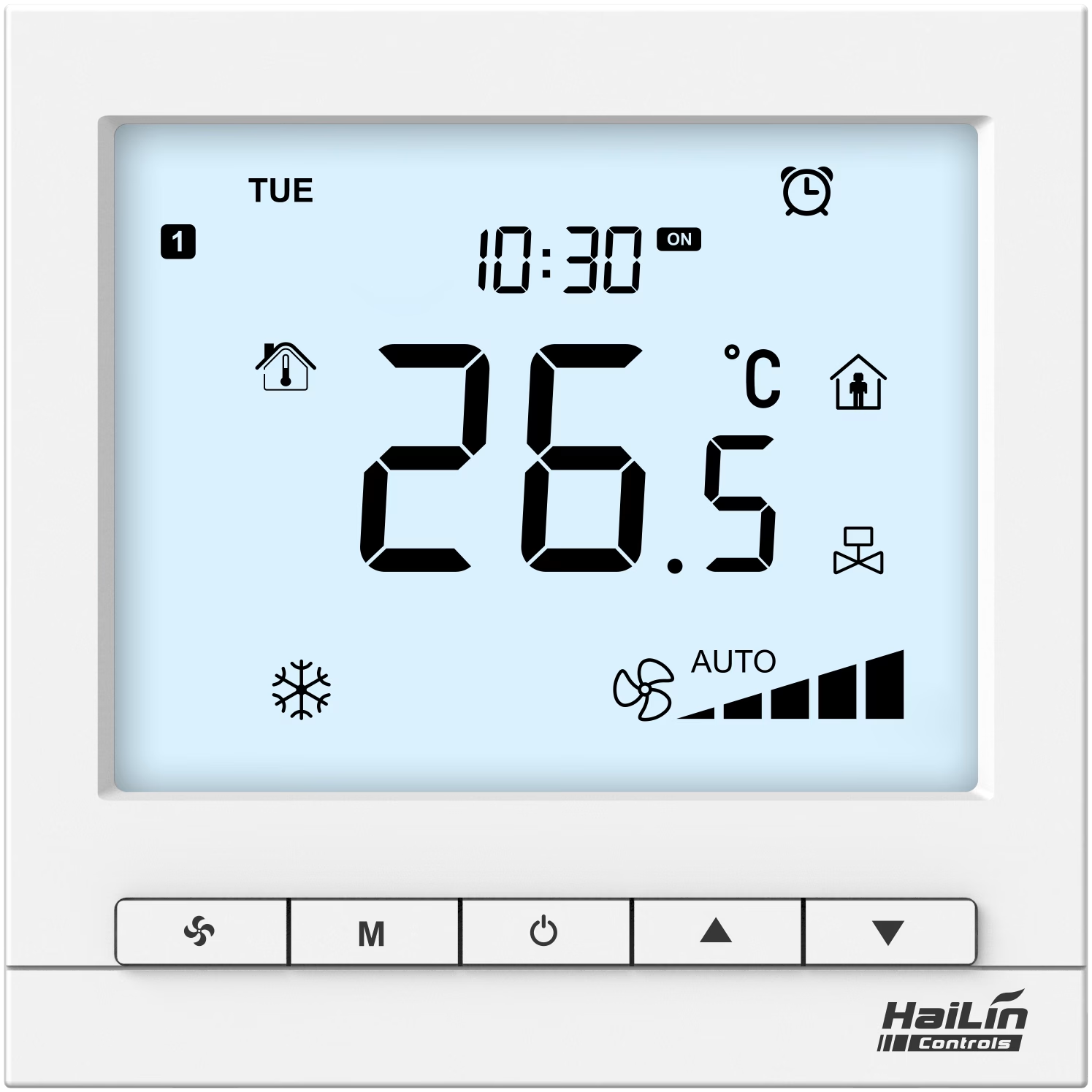
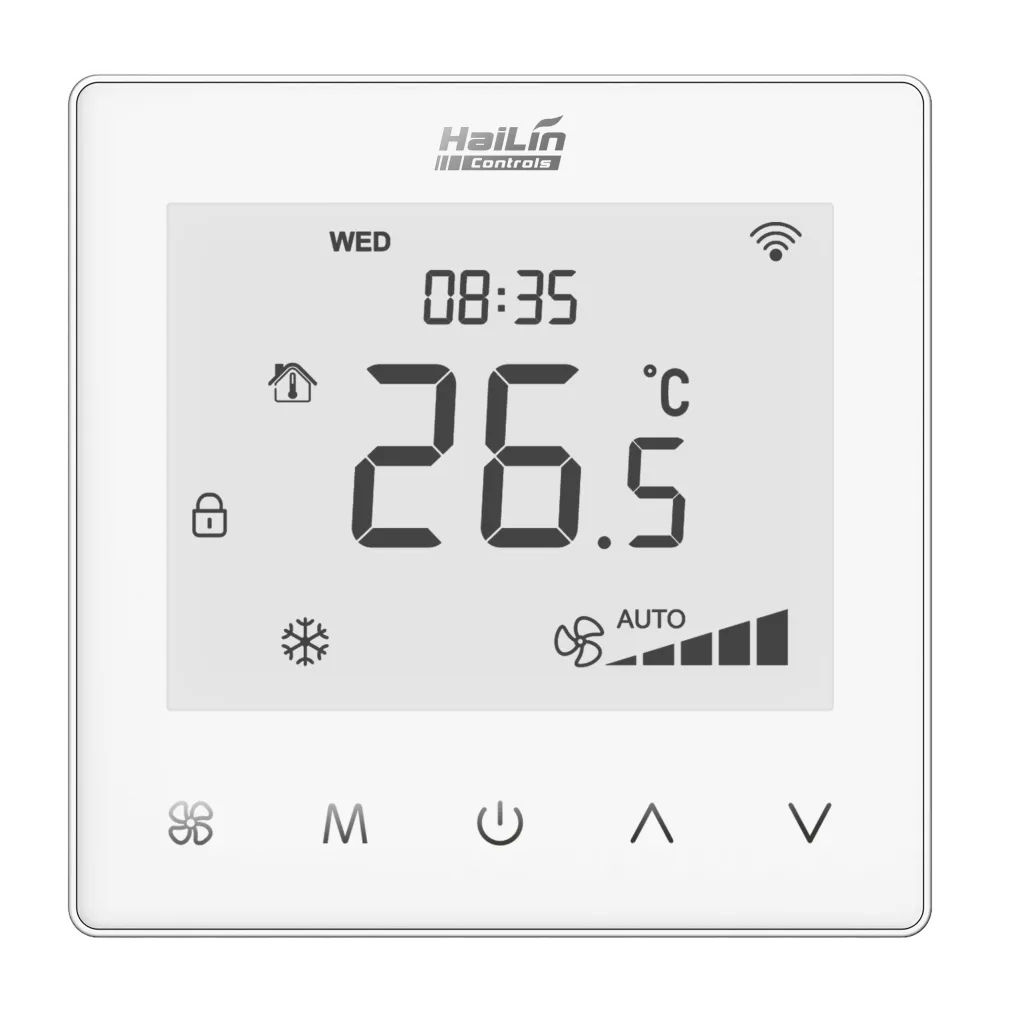
The Versatiled Series combines practical HVAC control functions with a compact wall-mounted design.
Key user interface features include:
These functions provide convenient local operation while helping prevent unwanted setting changes in managed environments.

Room Temp Accuracy: +1°C
Display Temp Resolution: 0.5°C
Environmental:
Operating Temperature Range: 0-45°C;
Storage Temperature Range: -10-60°C
Operating Humidity Range: 5-95% RH (no condensation)
Power Consumption: <2 W
Power Supply: AC85-250V, 50/60Hz
Terminations:
Hydronic Heating Model: one 2.5mm2 or two 1.5mm2 wires
Electrical Heating Model: one 4mm2
Max Load Current:
Hydronic Heating Model: <2A (resistive), <1A (inductive)
Electrical Heating Model: <16A (resistive), <6A (inductive)
Dim. H x W x D(mm): 86x86x15.5
Mounting Hole Dim.: 60mm
Protection Class: IP30
Compatible Remote Sensor Type: NTC10k B=3950
| Model | Connectivity | Type of FCU | Type of Actuator | Type of Fan AC 3-Speed Motor Fan | OnOff Timer | Schedule 7-4 (4 periods) | Power Supply | Remote Sensor | Note | ||
| RS-485 | 2-Pipe | 4-Pipe | 220V | 24V | |||||||
| HL2123DA | √ | 0~10V | √ | √ | √ | √ | √ | FCU with PI Control Valve | |||
| HL2123DB | √ | 0~10V | √ | √ | √ | √ | √ | ||||
| HL2123FCV2 | √ | 0~10V | √ | √ | √ | √ | √ | ||||
| HL8123DA | √ | √ | 0~10V | √ | √ | √ | √ | √ | |||
| HL8123DB | √ | √ | 0~10V | √ | √ | √ | √ | √ | |||
| HL8123FCV2 | √ | √ | 0~10V | √ | √ | √ | √ | √ | |||
| HL2123V2-E | √ | 0~10V | √ | √ | √ | √ | |||||
| HL2123V4-E | √ | 0~10V | √ | √ | √ | √ | |||||
| HL2123DA-E | √ | 0~10V | √ | √ | √ | √ | √ | ||||
| HL2123DB-E | √ | 0~10V | √ | √ | √ | √ | √ | ||||
| HL2123FCV2-E | √ | 0~10V | √ | √ | √ | √ | √ | ||||
| HL8123V2-E | √ | √ | 0~10V | √ | √ | √ | √ | ||||
| HL8123V4-E | √ | √ | 0~10V | √ | √ | √ | √ | ||||
| HL8123DA-E | √ | √ | 0~10V | √ | √ | √ | √ | √ | |||
| HL8123DB-E | √ | √ | 0~10V | √ | √ | √ | √ | √ | |||
| HL8123FCV2-E | √ | √ | 0~10V | √ | √ | √ | √ | √ | |||
The Versatiled Series is designed for HVAC terminal and equipment control across different building environments.

The thermostat can provide precise room temperature control for offices, commercial complexes, and other buildings using hydronic HVAC systems.
In hotel rooms and other hospitality spaces, PI control can regulate the connected HVAC valve according to room temperature requirements. Programmable scheduling and centralized communication can also support broader building automation strategies.

Healthcare environments require stable indoor conditions and reliable HVAC operation. The thermostat can be used as a room-level control device within a larger building automation system.
For residential applications, the thermostat provides local control of room temperature and compatible HVAC equipment while supporting different system configurations.
The thermostat can be deployed in public facilities where distributed room temperature control and centralized HVAC management are required.
The 0–10V output allows compatible modulating valves to be controlled in fresh air units and air handling units.
For hydronic heat exchange applications, PI control can regulate the valve output according to temperature demand.
HaiLin's solution portfolio covers multiple building types and HVAC applications, with products designed to work together as part of integrated building and energy management systems.
Precise temperature control is an important part of efficient HVAC operation.
With PI control, the thermostat continuously adjusts the modulating valve output instead of relying only on full-on or full-off switching. This allows the heating or cooling capacity to respond more closely to the actual room temperature demand.
For buildings with multiple zones, this type of proportional control can support more stable room conditions and better coordination between room demand and HVAC output.
The use of PI or PID control is widely established in temperature-control applications. West Control Solutions describes closed-loop proportional control as a method for adjusting output according to the deviation from the desired setpoint, while its PI control definition specifically identifies PI control as suitable for modulating valves.
The Versatiled Series can be used as part of a larger HVAC control system.
A complete project may combine:
HaiLin Controls' product portfolio covers these different control layers, including DDC controllers, sensors, gateways, thermostats, and motorized valves.
This allows the Versatiled Series to serve as a field-level room controller while other HaiLin products provide higher-level system control and management.
HaiLin Controls specializes in HVAC automation and building control solutions, with a product portfolio covering thermostats, sensors, controllers, gateways, valves, and building management platforms.
The company provides products and solutions for commercial buildings, hotels, healthcare facilities, public buildings, residential applications, and other HVAC automation projects.
For project customers, HaiLin can support the complete process from product selection and technical consultation to system integration and after-sales service.
Key capabilities include:
HaiLin states that its HVAC automation business is supported by in-house R&D, more than 300 patents, automated manufacturing, and internationally certified product reliability.
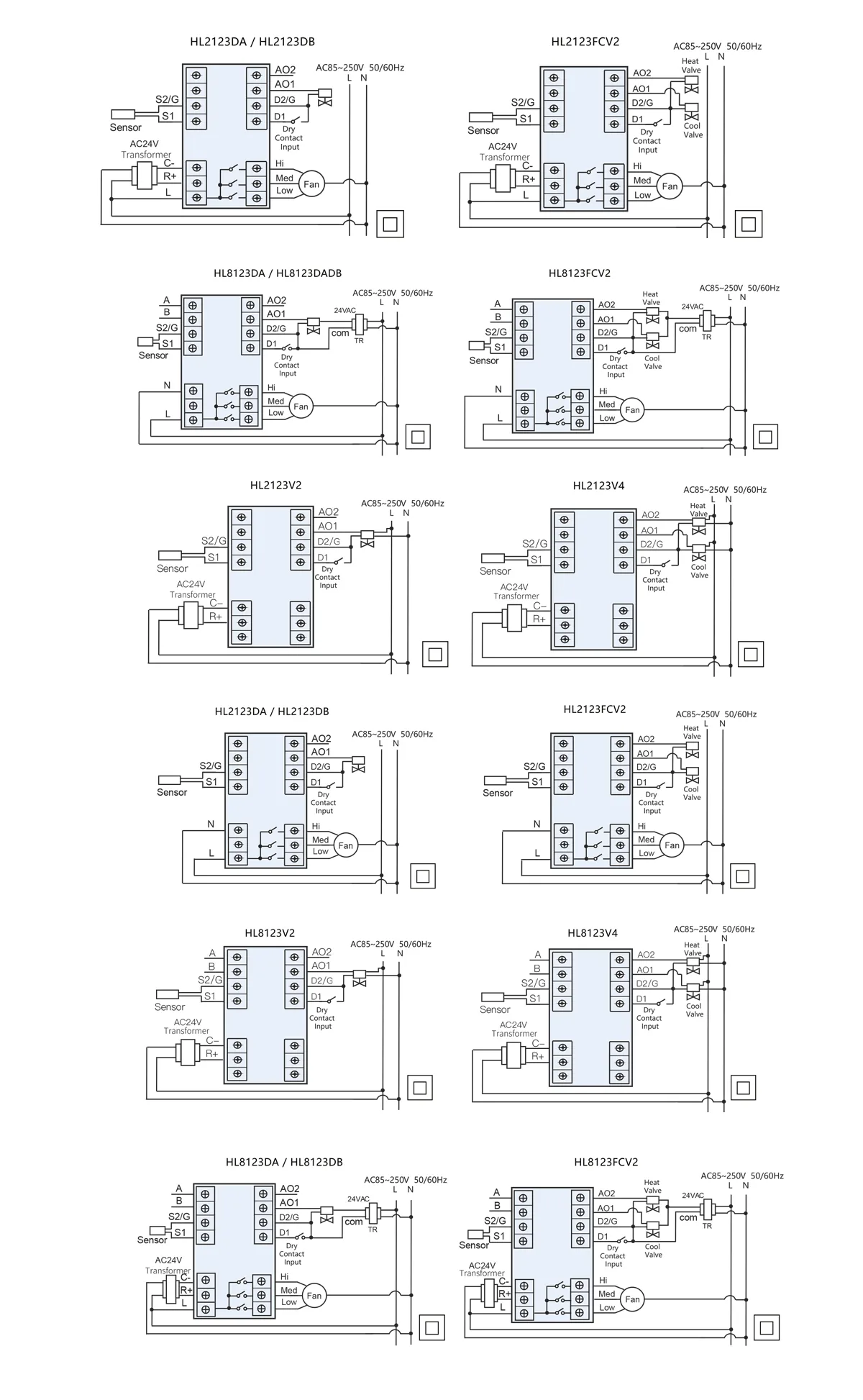
The Versatiled Series includes different wiring configurations depending on the model, power supply, actuator type, fan configuration, and communication requirements.

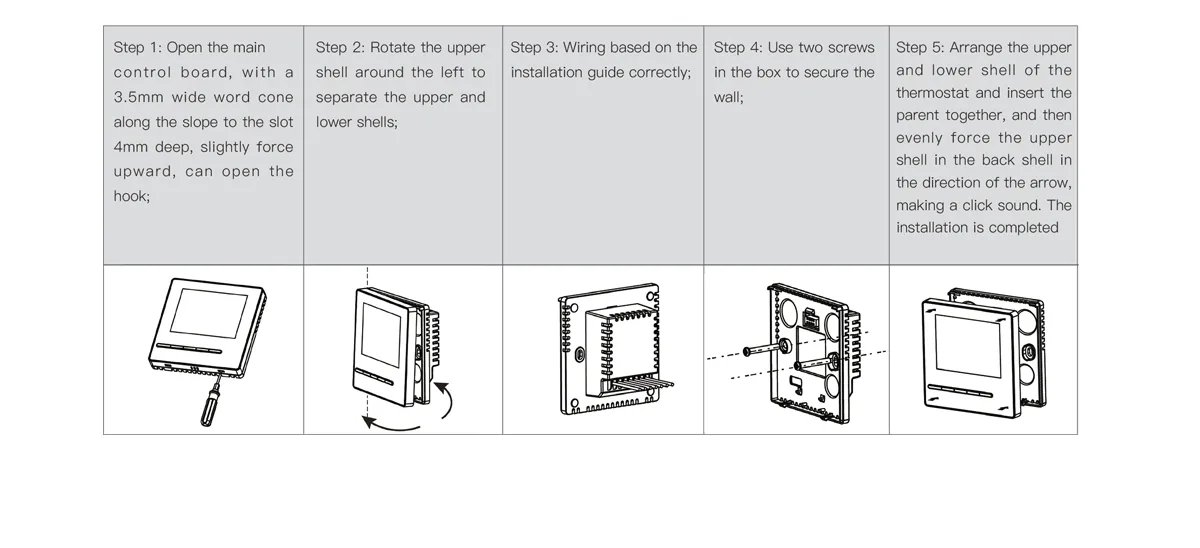
Before installation:
Download: Versatiled Series PI Control Thermostat Installation Instructions
Both PI and PID use proportional and integral control. PID additionally introduces derivative control.
For modulating valve applications, PI control can be advantageous because it does not include the derivative component that may cause unnecessary valve movement. West Control Solutions specifically describes PI control as proportional-integral control used for modulating valves.

Yes. The series includes models designed for 2-pipe and 4-pipe FCU systems and can provide fan and valve control according to the selected model.

A conventional FCU thermostat may use on/off valve control, while a PI control thermostat can continuously adjust a modulating valve through an analog output such as 0–10V.
This makes PI control particularly suitable for HVAC systems where more precise and stable valve regulation is required.
Explore other HaiLin Controls products for complete HVAC and building automation solutions:
Related Links:
Our technical team can assist with model selection according to the FCU configuration, valve type, communication requirements, remote sensor requirements, and overall HVAC control architecture.


We value your privacy
We use cookies to enhance your browsing experience, serve personalised ads or content, and analyse our traffic. By clicking "Accept All", you consent to our use of cookies.
Customise Consent Preferences
We use cookies to help you navigate efficiently and perform certain functions. You will find detailed information about all cookies under each consent category below.
The cookies that are categorised as "Necessary" are stored on your browser as they are essential for enabling the basic functionalities of the site. Show more
Necessary cookies are required to enable the basic features of this site, such as providing secure log-in or adjusting your consent preferences. These cookies do not store any personally identifiable data.
Functional cookies help perform certain functionalities like sharing the content of the website on social media platforms, collecting feedback, and other third-party features.
Analytical cookies are used to understand how visitors interact with the website. These cookies help provide information on metrics such as the number of visitors, bounce rate, traffic source, etc.
Performance cookies are used to understand and analyse the key performance indexes of the website which helps in delivering a better user experience for the visitors.
Advertisement cookies are used to provide visitors with customised advertisements based on the pages you visited previously and to analyse the effectiveness of the ad campaigns.