Reliable Duct Air Temperature & Humidity Measurement
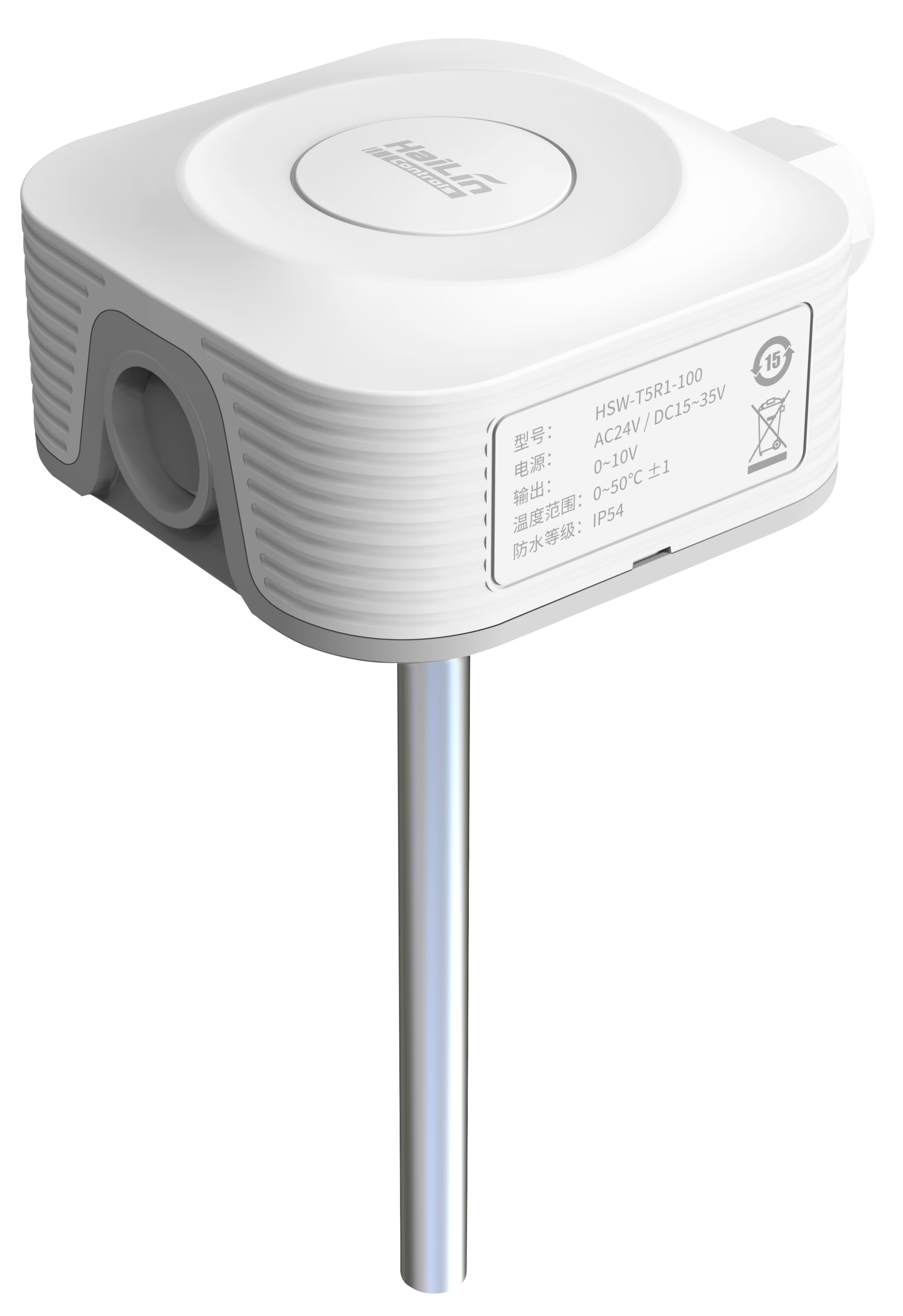
The HSD Series is designed for direct measurement of air conditions inside ventilation and HVAC ducts. By continuously collecting duct air temperature and humidity data, the sensor provides essential environmental information for HVAC controllers and building automation systems.
Different models are available for projects with different sensing and signal requirements. Temperature measurement can use PT1000, NTC10K or NTC20K sensing elements, while transmitter models provide 0–10V or 4–20mA outputs.
For integrated monitoring and communication, selected models combine temperature and humidity measurement with RS-485 communication, supporting Modbus for system-level integration.
Duct-Mounted Measurement
The probe is designed for installation inside an air duct, allowing the sensor to measure the actual air conditions within the ventilation path rather than relying on room-side measurements.
Multiple Temperature Sensing Options
The HSD Series includes models using PT1000, NTC10K and NTC20K temperature sensing technologies, providing options for different HVAC control system requirements.
Analog and Digital Outputs
Depending on the model, measurement signals can be provided through 0–10V, 4–20mA or RS-485 interfaces. This makes it easier to match the sensor with different HVAC controllers and building automation architectures.
Combined Temperature & Humidity Measurement
Selected HSD models measure both air temperature and relative humidity, providing two important parameters for monitoring duct air conditions and supporting HVAC environmental control.
Flexible Sensor Models for Different HVAC Systems
The HSD Series is available in multiple configurations to accommodate different temperature ranges, humidity ranges, sensing elements and output signals.
Temperature Sensor Models
For applications requiring duct air temperature measurement, the series includes models with:
- PT1000 temperature sensing
- NTC10K temperature sensing
- NTC20K temperature sensing
- 0–10V temperature output
- 4–20mA temperature output
- RS-485 temperature communication
These configurations allow system designers to select a suitable duct temperature sensor according to the controller input and project requirements.
Temperature & Humidity Sensor Models
For applications requiring simultaneous measurement of temperature and humidity, selected models provide:
- 0–100% RH humidity measurement
- 0–10V humidity output
- 4–20mA humidity output
- RS-485 communication
- Modbus protocol support
This configuration is suitable for HVAC systems where both duct temperature and relative humidity need to be monitored by a centralized control system.
Different Measurement Ranges
Different HSD models support different temperature measurement ranges, including options covering approximately -20°C to 80°C and 0°C to 50°C, depending on the model.
Humidity measurement models can support up to 0–100% RH.
This range of configurations allows the HSD Series to serve different air duct monitoring and HVAC control requirements.
Multiple Output Signals for Easy System Integration
A key advantage of the HSD Series is its range of signal output options. Different HVAC controllers and building automation systems may require different input interfaces, so the sensor series provides several ways to transmit measurement data.
PT1000 and NTC Outputs
Models using PT1000, NTC10K or NTC20K provide temperature sensing options for control systems designed for resistance-based temperature inputs.
These models are suitable when the connected HVAC controller or thermostat is designed to directly process the corresponding resistance signal.
RS-485 & Modbus Communication
Selected HSD models use RS-485 communication for digital data transmission.
With Modbus protocol support, the sensor can communicate with compatible controllers and building automation systems, reducing the need for separate analog input channels and simplifying system integration.
Designed for HVAC Air Duct Monitoring
The HSD Series provides measurement data that can be used as an input for HVAC monitoring and control.
Installed inside an air duct, the sensor can monitor air conditions at key points in a ventilation or air-conditioning system.
Supply Air Monitoring
Monitor the temperature and humidity of supply air after air treatment or conditioning.
This information can be provided to the HVAC control system for monitoring and control purposes.
Return Air Monitoring
Measure return air conditions to provide information about the air entering the HVAC equipment.
Return air temperature and humidity data can be used as an input for HVAC system monitoring and control strategies.
Ventilation System Monitoring
The sensor can be installed in suitable ventilation ducts to measure air conditions and provide data to the connected control system.
This is useful for air handling and ventilation monitoring where duct-level environmental information is required.
Air Handling Unit Monitoring
The HSD Series can be used at appropriate measurement points within air handling unit (AHU) systems to monitor duct air temperature and humidity.
The measurement data can be transmitted through the selected sensor output to a compatible HVAC controller or building automation system.
Easy Integration with Building Automation Systems
The HSD Series is designed to provide measurement signals that can be directly connected to compatible HVAC controllers, DDC controllers and building automation systems.
The available communication method depends on the selected model.
Analog HVAC Control Integration
Models with 0–10V and 4–20mA outputs can connect to compatible analog inputs on HVAC controllers or DDC controllers.
This provides a straightforward solution for projects using conventional analog sensor inputs.
Resistance-Based Temperature Measurement
PT1000, NTC10K and NTC20K models can be selected when the connected controller is designed to accept resistance-based temperature signals.
This provides additional flexibility when replacing or expanding existing temperature sensing systems.
Digital Communication
Models equipped with RS-485 can transmit measurement data digitally to compatible control systems.
With Modbus communication, multiple sensor parameters can be integrated into a centralized building automation architecture, depending on the system configuration.
Specifications
| Model | Temperature measure range | Humidity measure range | Temperature signal output | Humidity signal output | Temperature accuracy | Humidity accuracy | Working voltage | Probe length | Working temperature and humidity | Protection level |
| HSD-T1-180 | -20~80℃ | | PT1000 | | ±0.2℃@0℃ | | No | 180mm | -25~70℃5~95% RH(No condensation) | IP54 |
| HSD-T2-180 | -20-80°C | | NTC10K | | +0.3°C@25°C | | | | | |
| HSD-T5-180 | -20-80°C | | NTC20K | | | | | | | |
| HSD-T3R0-180 | 0-50°C/40-60°C | | 0-10V | | | AC24V±20%/DC15-35V | -40-80°C5-95% RH(No condensation) | |
| HSD-T4R0-180 | 0-50°C/40-60°C | | 4-20ma | | | | | |
| HSD-T3H1R1X-180 | 0-50°C | 0~100%RH | 0-10V/RS-485 | 0~10V/RS-485 | ±0.5°@25°C | ±5% RH | -25-70°C5-95% RH(No condensation) |
| HSD-T3H1R3X-180 | -20-80°C |
| HSD-T3H1R0-180 | 0~50°C/40-60°C | 0-10V | 0-10V | ±0.3°C@25°C | ±3RH%(20~80%)±5RH%(0-100%) | -40-80°C5~95% RH(No condensation) |
| HSD-T4H2R0-180 | 4~20Ma | 4~20Ma | ±0.3°C@25°C |
| HSD-ROX-180 | RS-485 | RS-485 | ±0.3°C@25°C |
Air Duct Temperature & Humidity Sensor Applications
The HSD Series can be installed at suitable points within HVAC and ventilation duct systems where continuous air temperature or humidity measurement is required.
Building HVAC Systems
Use the sensor to monitor air conditions within commercial building HVAC systems and provide measurement signals to connected control equipment.
Air Handling Units
Install the sensor at suitable duct sections of AHU systems to monitor supply or return air conditions.
Ventilation Systems
Monitor air temperature and humidity in ventilation ducts to provide environmental data for compatible ventilation and HVAC control systems.
Commercial Buildings
The sensor can support building automation systems in offices, commercial complexes, public buildings and other facilities where duct-level environmental monitoring is required.
HVAC Control Panels
Connect compatible HSD models to DDC controllers, HVAC controllers or control panels using the required resistance, voltage, current or RS-485 signal.
Select the Right HSD Sensor for Your Project
Different HVAC projects require different sensor interfaces and measurement ranges. The HSD Series provides multiple configurations so that the sensor can be matched to the connected control system.
For temperature-only measurement:
Choose a model with PT1000, NTC10K, NTC20K, 0–10V, 4–20mA or RS-485 output according to the controller input.
For temperature and humidity measurement:
Choose a combined duct temperature and humidity sensor with the required analog or RS-485 output.
For digital system integration:
Select an RS-485 / Modbus model for compatible building automation and HVAC control systems.
For analog control systems:
Select a model with 0–10V or 4–20mA output according to the controller specification.