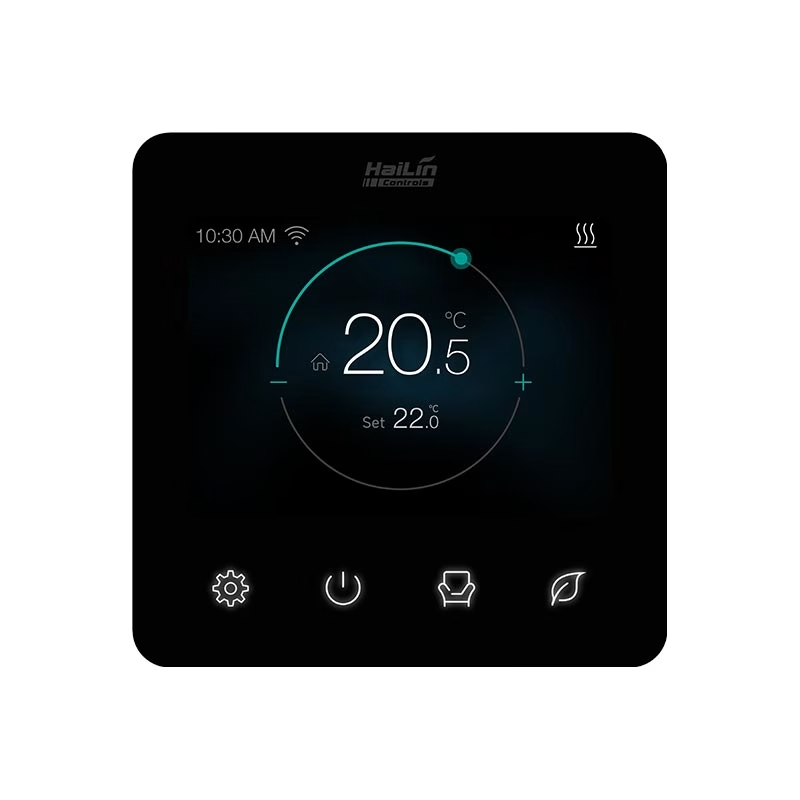
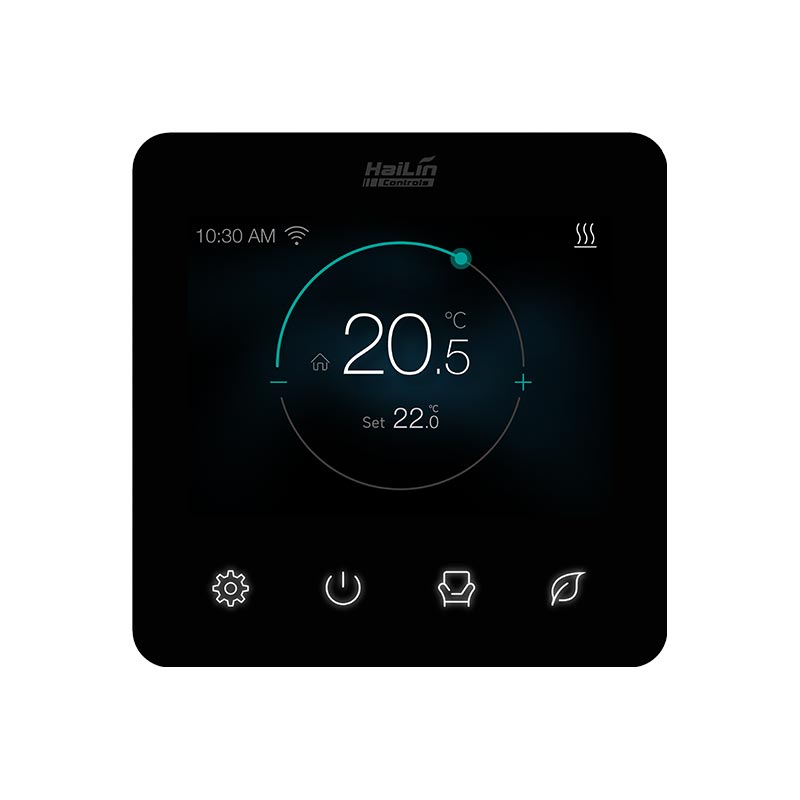
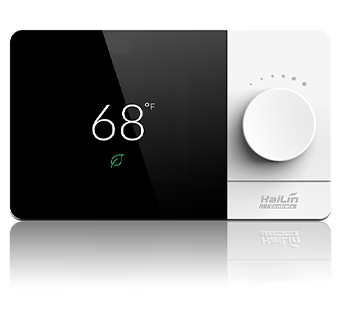
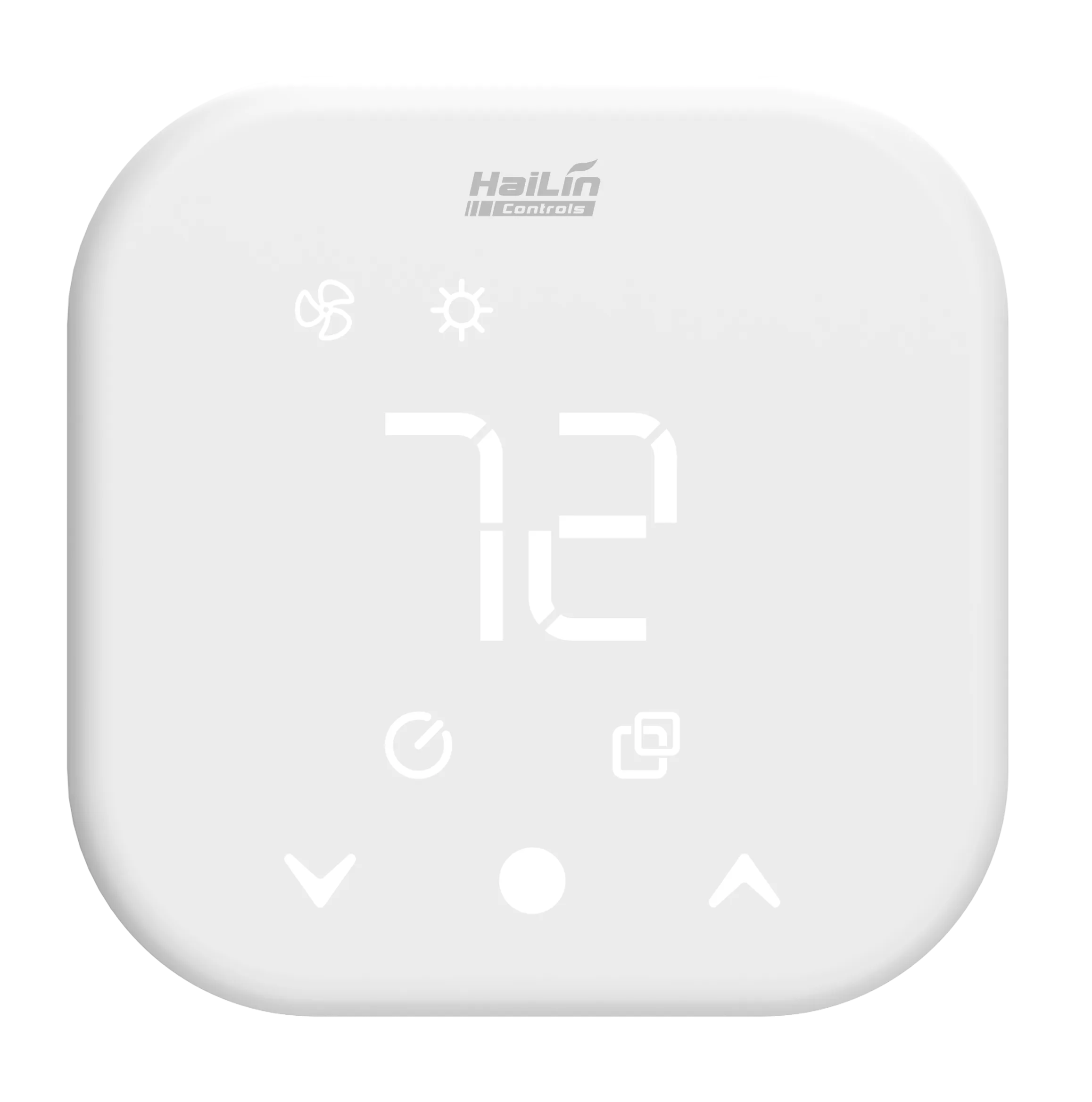
ViviD series thermostat has sleek color touch screen and concise user interface which makes interaction smooth and efficient. It providesprecise temperature control and enjoy features like nighttime dimmer,confgurable display and scenario mode control. Local schedule and remote control via free mobile app makes it easy to improve comfort and save energy. ViviD has one RS-485 port which can be integrated by BA System via Modbus-RTU protocol.
The ViviD Series Fan Coil Thermostat is a color touchscreen thermostat designed for fan coil unit (FCU) temperature control in commercial and residential HVAC systems. With a 480 × 320 color TFT display, configurable screen settings, adjustable brightness, and a nighttime dimmer, ViviD provides clear and convenient local control while maintaining a compact 86 × 86 mm wall-mounted design.
The series includes models for 2-pipe and 4-pipe fan coil units, supporting conventional on/off valve control, modulating valve control, and selected FCU with floor heating applications. Depending on the model, Wi-Fi connectivity enables remote control through a mobile app, while RS-485 communication with Modbus-RTU allows integration with a building automation system.
With programmable schedules, timer control, scenario modes, anti-freezing protection, and configurable temperature hysteresis, the ViviD Series can be used for room-level HVAC control in hotels, offices, commercial buildings, residential buildings, and other building automation applications.
The ViviD Series features a color TFT touchscreen with a 480 × 320 resolution, providing an intuitive interface for room temperature adjustment, operating mode selection, fan control, and other thermostat settings.
Display information and brightness can be configured according to project requirements. The nighttime dimmer reduces screen brightness when the room is not in active use, making the thermostat more suitable for bedrooms and hotel rooms.
Different models support 2-pipe and 4-pipe fan coil systems, allowing the thermostat to be matched to different hydronic HVAC configurations.
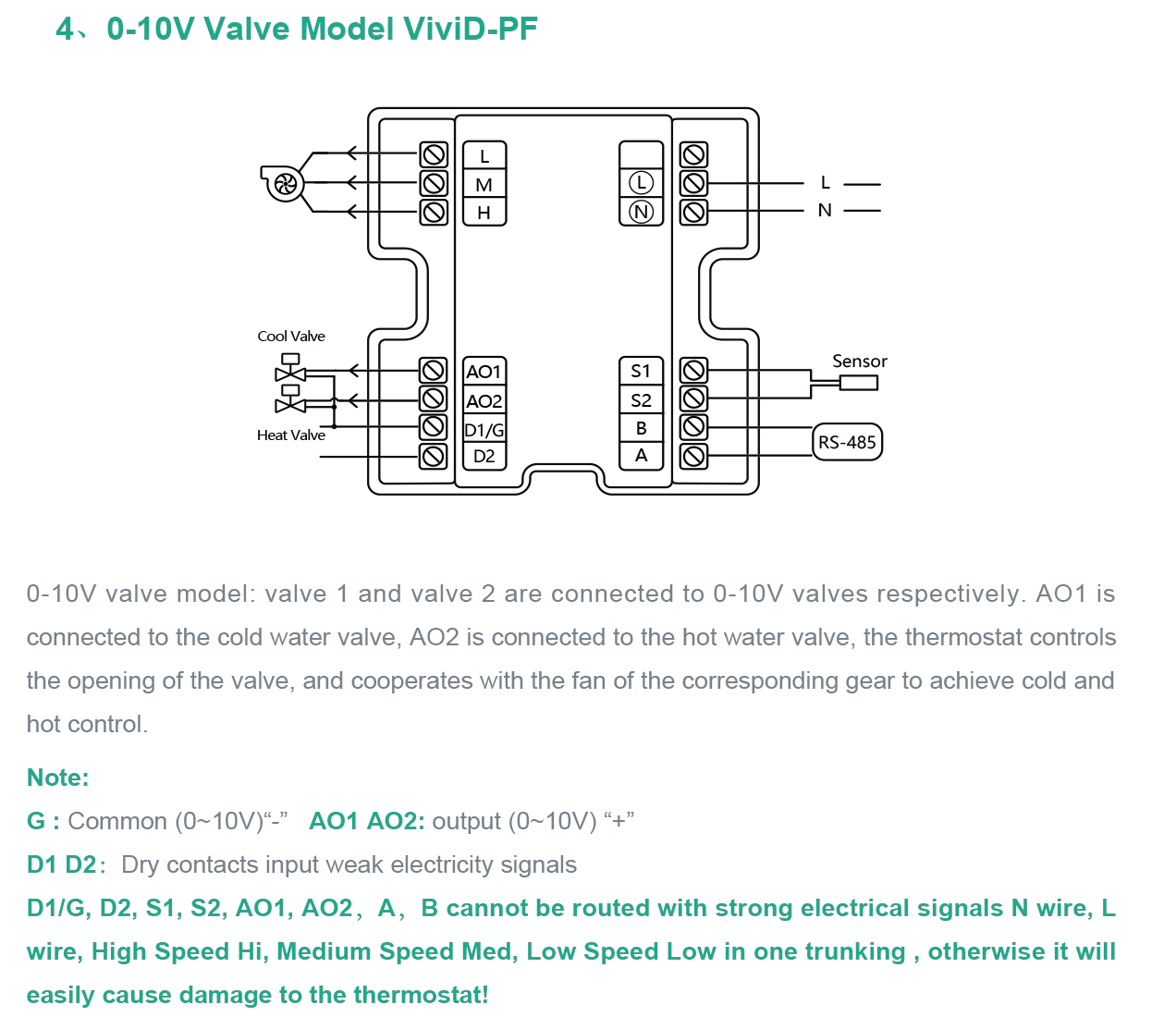
The ViviD-F model is designed for on/off valve and 3-speed fan control, while the ViviD-PF supports modulating valve and 3-speed fan control for applications requiring more flexible temperature regulation.
The thermostat supports Wi-Fi and RS-485 communication depending on the model. Wi-Fi-enabled models can provide remote control through the mobile app, while the RS-485 interface can be integrated into a building automation system through Modbus-RTU.
The built-in schedule supports 7-day programming with 4 events per day, allowing HVAC operation to follow occupancy patterns and daily routines. Timer functions are also available for temporary operating control.
Scenario mode allows predefined operating settings to be selected according to different room-use requirements, simplifying daily HVAC control.
One UI can be configured for a remote temperature sensor or room card depending on the application, providing additional flexibility for room-level HVAC control.
One DO is available for linked control applications where the thermostat needs to coordinate with another connected device.
The anti-freezing function helps protect the HVAC system when room temperature falls to a low level.
The configurable hysteresis allows the temperature control range to be adjusted according to system requirements, helping reduce unnecessary equipment cycling.
The thermostat supports operation after power restoration and OTA updates, helping maintain configuration and simplify product maintenance where supported.
| Specification | ViviD Series |
|---|---|
| Product Type | Fan Coil Thermostat |
| Display | Color TFT touchscreen |
| Display Resolution | 480 × 320 |
| Display Temperature Resolution | 0.1°C |
| Room Temperature Accuracy | ±1°C* |
| Power Supply | AC 85–250V, 50/60Hz |
| Power Consumption | <3W |
| Operating Temperature | 0–50°C |
| Operating Humidity | 5–95% RH, non-condensing |
| Max. Load Current | <2A resistive, <1A inductive |
| Terminations | One 2.5 mm² or two 1.5 mm² wires |
| Dimensions (H × W × D) | 86 × 86 × 12 mm |
| Mounting Hole Spacing | 60 mm |
| Protection Class | IP30 |
| Communication | RS-485 + Wi-Fi, model dependent |
| Communication Protocol | Modbus-RTU via RS-485 |
| Certification | CE |
| Model | Application | Commun ication | Certificate | FCU/Stage | Power Supply | IP level | Timer | Schedule |
| ViviD-F | FCU(ON/OFF valve & 3 speed fan) | RS485+WIFI | CE | 2/4-pipe | 90-240VAC | IP30 | - | 7 days 4 events |
| ViviD-PF | FCU(modulating valve & 3 speed fan) | RS485+WIFI | CE | 2/4-pipe | 90-240VAC | IP30 | - | 7 days 4 events |
| ViviD-FW | FCU+Flloor heating | RS485+WIFI(Tuya) | CE | 2-pipe | 90-240VAC | IP30 | - | 7 days 4 events |
Choose ViviD-F for conventional 2-pipe or 4-pipe FCU systems with on/off valve control and a 3-speed fan.
Choose ViviD-PF when the FCU uses a modulating valve with a 3-speed fan.
Choose ViviD-FW for a 2-pipe FCU combined with floor heating and a Tuya-based Wi-Fi application.
For a project using a different fan motor, valve actuator, or power supply, the model should be checked against the actual terminal-unit wiring and control requirements before selection.
The ViviD Series is designed for room-level HVAC control where a fan coil thermostat needs to combine local temperature adjustment with scheduling, remote access, or building automation integration.
Typical applications include:
Hotel rooms and hospitality buildings requiring local temperature control and remote management
Office buildings using 2-pipe or 4-pipe fan coil units
Commercial buildings with room-by-room HVAC control
Residential buildings using hydronic fan coil systems
Apartments and residential communities requiring programmable room temperature control
Building automation projects where compatible models are connected through RS-485 and Modbus-RTU
FCU + floor heating systems using the ViviD-FW model
The thermostat can also be incorporated into broader HVAC and building automation projects. For building-level applications, relevant HaiLin solutions include hotel building automation, commercial building solutions, smart hospital solutions, and smart laboratory solutions.
The ViviD Series can be used as a standalone room thermostat or as part of a connected HVAC control system, depending on the selected model.
Wi-Fi connectivity provides remote access through the supported mobile application, allowing users to adjust room temperature and manage thermostat settings without being physically present in the room.
For building automation applications, the thermostat provides an RS-485 interface and supports integration through the Modbus-RTU protocol. This allows compatible ViviD models to communicate with a building automation system for centralized HVAC management.
The combination of local touchscreen operation, Wi-Fi remote access, and RS-485 communication makes ViviD suitable for projects that require both room-level control and centralized building management.
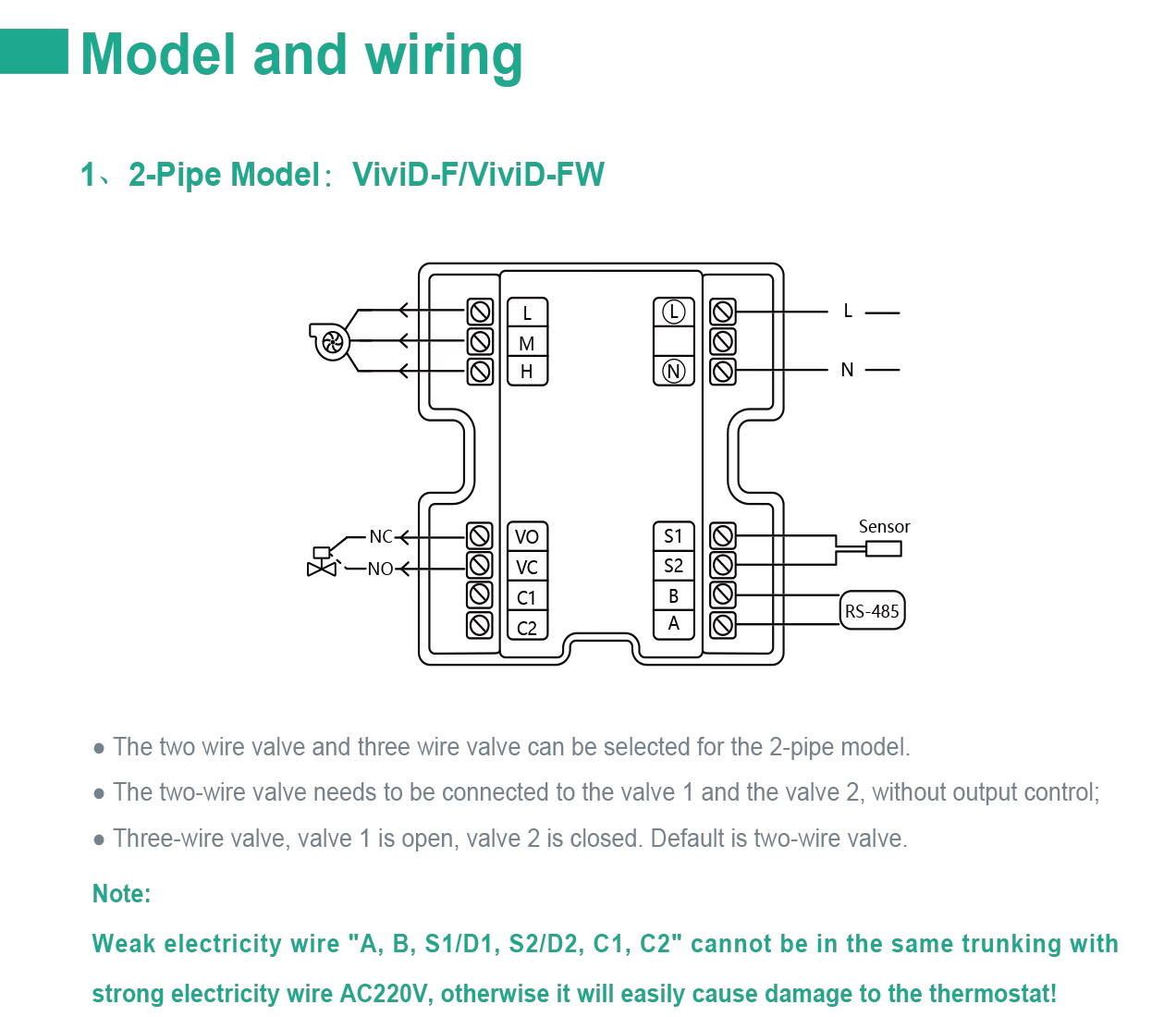
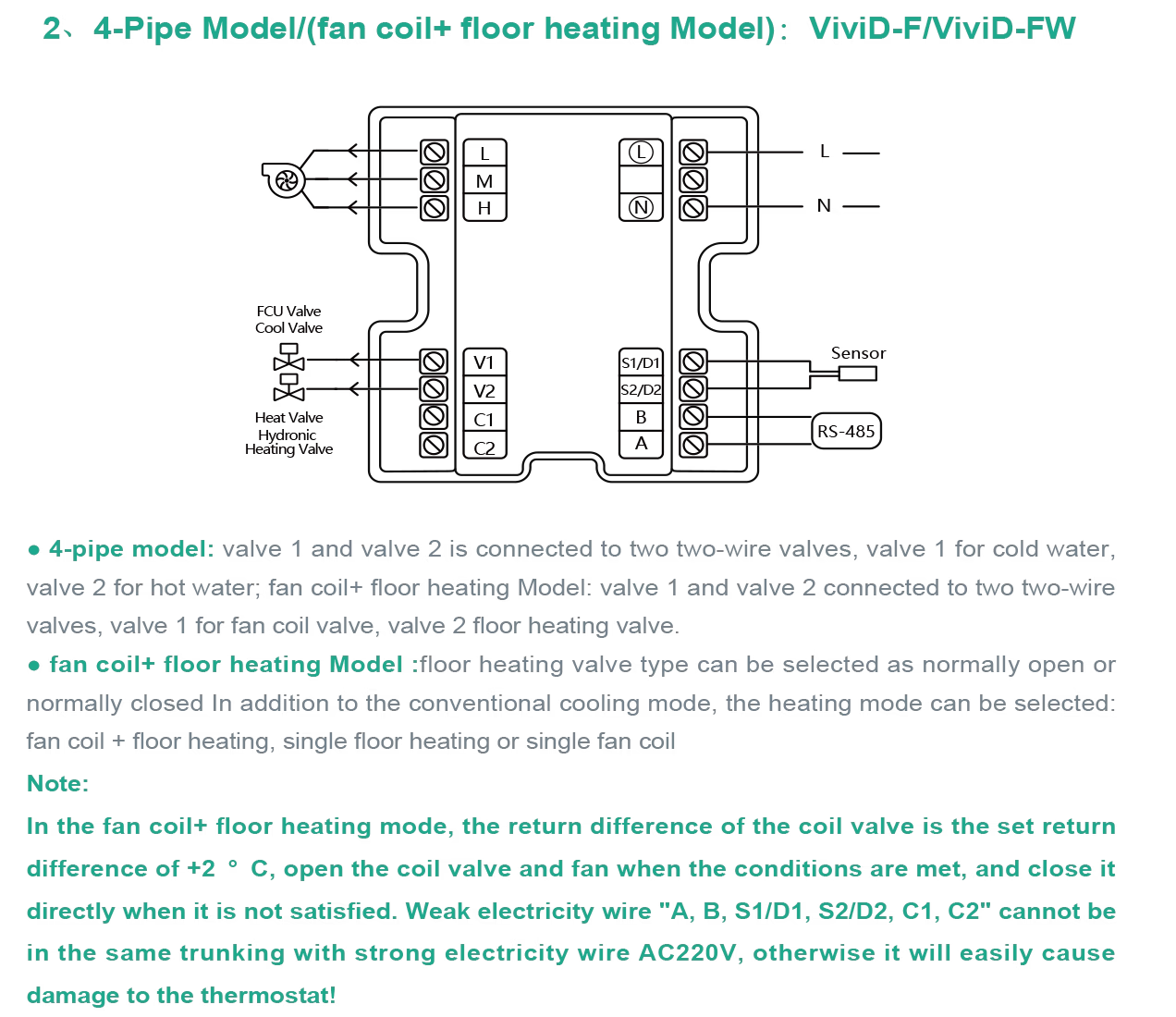
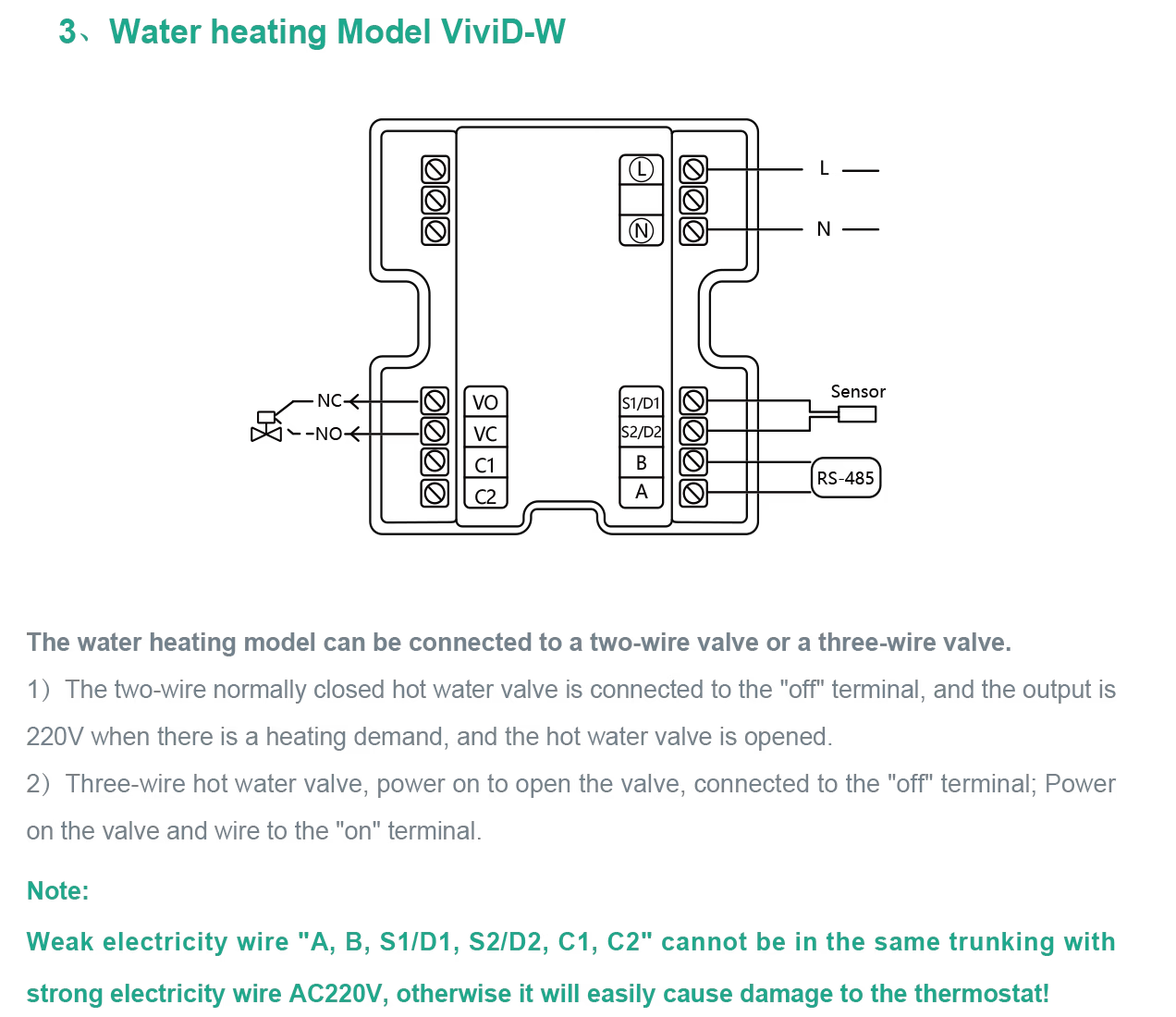
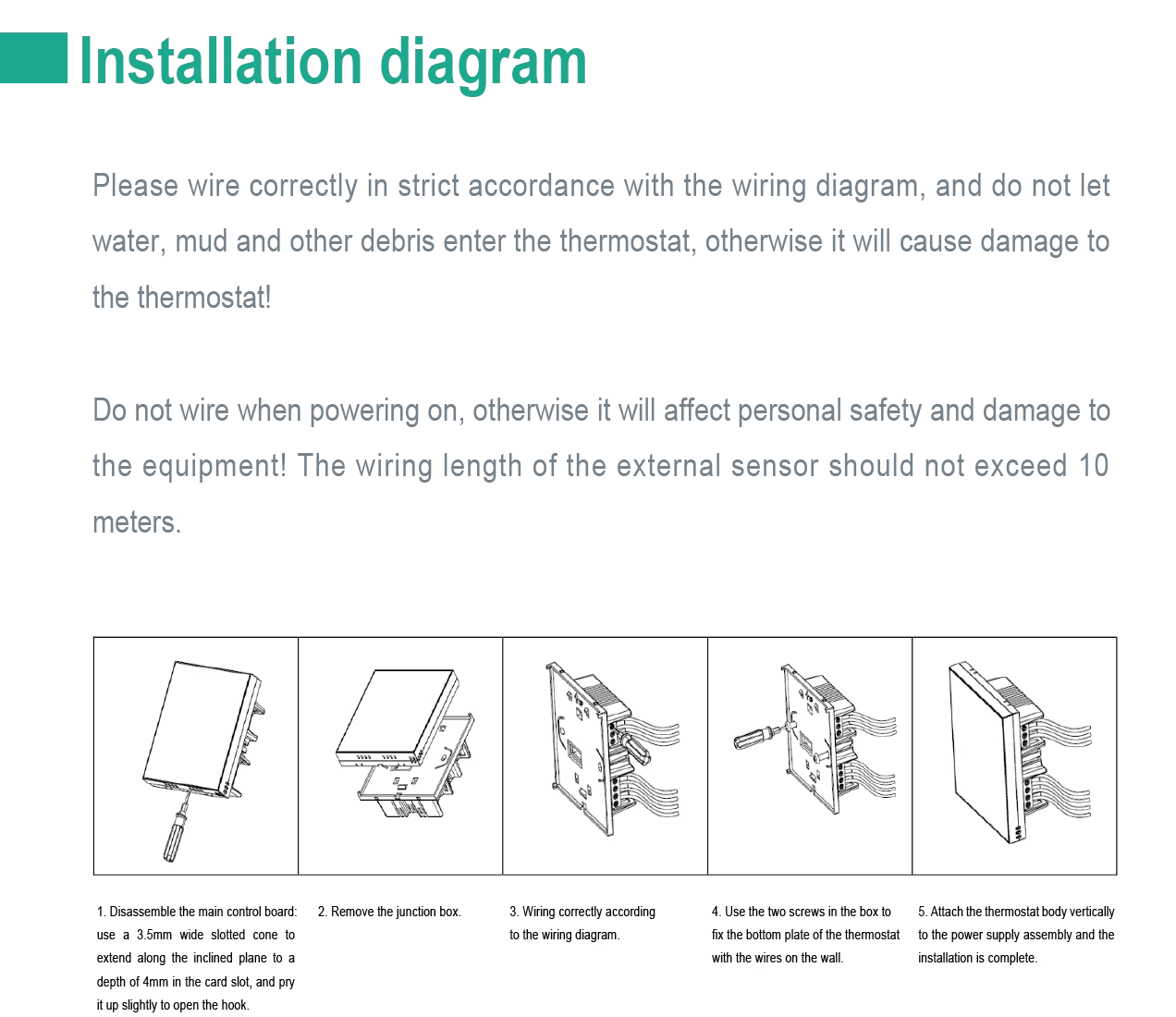
The ViviD Series uses an 86 × 86 mm wall-mounted format with a 60 mm mounting-hole spacing. Before installation, the selected thermostat model should be matched with the FCU piping configuration, valve type, fan control method, power supply, and communication requirements.
Because terminal assignments may differ between models, the wiring diagram provided for the specific ViviD model should be followed during installation.
For projects replacing an existing thermostat, installers should also verify the existing FCU valve actuator and fan wiring before selecting the replacement model.
The ViviD Series is a fan coil thermostat with a color touchscreen designed for room temperature control. Depending on the model, it supports 2-pipe or 4-pipe FCU systems, on/off or modulating valve control, 3-speed fan control, Wi-Fi, and RS-485 communication.
Yes. ViviD-F and ViviD-PF support both 2-pipe and 4-pipe FCU configurations according to the current model list. ViviD-FW is designed for a 2-pipe FCU combined with floor heating.
Yes. The model list specifies RS-485 + Wi-Fi communication for ViviD-F and ViviD-PF, while ViviD-FW is specified as RS-485 + Wi-Fi (Tuya). The available remote-control functions depend on the selected model and supported application.
Yes. Its touchscreen interface, scheduling, remote-control capabilities, and building automation integration make the series suitable for room-level HVAC control in hotels, offices, commercial buildings, and residential applications.
Model selection should be based primarily on the FCU configuration, valve type, fan control method, floor-heating requirement, and communication requirements. ViviD-F is for on/off valve control, ViviD-PF is for modulating valve control, and ViviD-FW is for FCU + floor heating applications.

We value your privacy
We use cookies to enhance your browsing experience, serve personalised ads or content, and analyse our traffic. By clicking "Accept All", you consent to our use of cookies.
Customise Consent Preferences
We use cookies to help you navigate efficiently and perform certain functions. You will find detailed information about all cookies under each consent category below.
The cookies that are categorised as "Necessary" are stored on your browser as they are essential for enabling the basic functionalities of the site. Show more
Necessary cookies are required to enable the basic features of this site, such as providing secure log-in or adjusting your consent preferences. These cookies do not store any personally identifiable data.
Functional cookies help perform certain functionalities like sharing the content of the website on social media platforms, collecting feedback, and other third-party features.
Analytical cookies are used to understand how visitors interact with the website. These cookies help provide information on metrics such as the number of visitors, bounce rate, traffic source, etc.
Performance cookies are used to understand and analyse the key performance indexes of the website which helps in delivering a better user experience for the visitors.
Advertisement cookies are used to provide visitors with customised advertisements based on the pages you visited previously and to analyse the effectiveness of the ad campaigns.